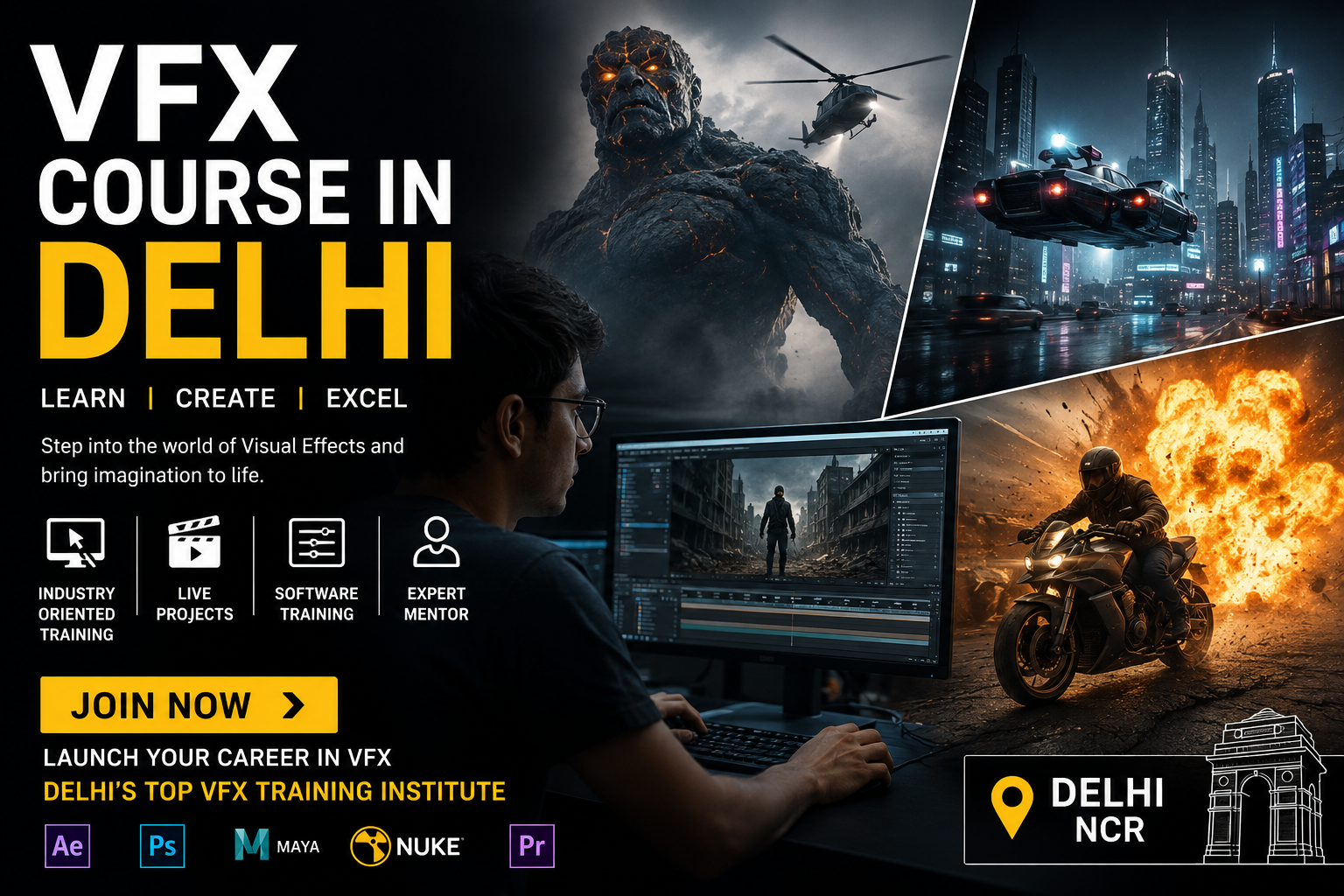
How to Choose the Best VFX Course in Delhi
The visual effects industry is growing rapidly in India, and Delhi has become one of the important education hubs for creative media courses. Students who dream of working in films, OTT platforms, gaming, advertising, animation, or digital content often begin their journey by enrolling in a VFX course in Delhi. However, with so many institutes offering different programs, choosing the right course can feel confusing.
Selecting the best course is not only about fees or location. A good VFX program should provide practical training, industry exposure, updated software knowledge, and career support. In this blog, we will discuss the most important factors you should consider before choosing the best VFX course in Delhi.
Understand What VFX Actually Includes
Before comparing institutes, you should understand what a VFX course teaches. Visual effects is a broad field that includes:
- Compositing
- Motion graphics
- 3D modeling
- Texturing
- Lighting
- Rendering
- Rotoscopy
- Match moving
- Green screen techniques
- Simulation and particle effects
Some institutes focus only on basic compositing, while others offer complete production-oriented training. Make sure the course covers the specialization that matches your career goals.
Research the Institute’s Reputation
The first step in choosing a VFX course in Delhi is checking the reputation of the institute. Look for:
- Years of operation
- Student reviews on Google and social media
- Alumni success stories
- Industry collaborations
- Awards or recognitions
A reputed institute generally has experienced faculty members and a structured training process. Do not rely only on advertisements; spend time reading genuine student feedback.
Check the Course Curriculum Carefully
Many students make the mistake of joining a course without reading the syllabus. Ask for a detailed curriculum and compare it with current industry requirements.
A strong VFX curriculum should include:
- Adobe After Effects
- Adobe Premiere Prohttps://www.adobe.com/in/products/premiere.html
- Nuke
- Autodesk Maya or 3ds Max
- Blender
- Houdini (advanced courses)
- Mocha tracking tools
- Color correction and compositing workflows
The curriculum should progress from fundamentals to advanced production techniques. If the syllabus has not been updated for several years, it may not prepare you for modern VFX jobs.
Evaluate Faculty Experience
Faculty quality directly affects your learning. Ask these questions:
- Have the trainers worked on real films, TV shows, OTT projects, or advertisements?
- How many years of industry experience do they have?
- Do they teach practical production workflows?
Experienced mentors can explain real-world challenges such as client revisions, render management, shot organization, and pipeline workflows. A good teacher can save you months of trial-and-error learning.
Visit the Campus Before Admission
Never take admission without visiting the institute. During your visit, check:
- Computer lab specifications
- Licensed software availability
- Internet speed
- Rendering systems
- Classroom environment
- Batch size
VFX work requires powerful systems. If the computers are outdated, you may struggle with rendering and simulation exercises.
Ask About Practical Training
VFX is a skill-based profession, so practical training is more important than theory. The best VFX course in Delhi should include:
- Daily hands-on exercises
- Shot-based assignments
- Mini projects
- Team projects
- Portfolio development
- Final production project
A course that focuses mainly on lectures is unlikely to build industry-ready skills.
Compare Course Duration
Course duration varies from three months to two years. Choose according to your goal.
Short-term courses (3–6 months):
- Good for beginners exploring VFX
- Focus on basic software skills
Diploma courses (9–15 months):
- Better for job-oriented training
- Include multiple software tools
Advanced programs (18–24 months):
- Suitable for students seeking specialization
- Include production pipeline and advanced effects
Do not assume that a longer course is always better. What matters is the quality of training and project work.
Placement Assistance Matters
One of the most important factors while choosing a VFX course in Delhi is placement support. Ask the institute:
- What companies hire their students?
- What is the placement record?
- Do they conduct interview preparation sessions?
- Is there portfolio review support?
- Are internships available?
Institutes that maintain industry connections can help students get internships and entry-level opportunities.
Review Student Portfolioshttps://www.theparag.xyz/archives/1198
Ask to see portfolios or showreels created by recent students. A portfolio reveals the actual training quality.
Look for:
- Clean compositing work
- Proper tracking
- Realistic lighting integration
- Smooth motion graphics
- Professional presentation
If student work looks weak despite long course durations, reconsider your choice.
Consider Fees and Value for Mone
Course fees in Delhi vary widely. Instead of choosing the cheapest option, compare what is included:
- Software access
- Study materials
- Project work
- Portfolio guidance
- Placement assistance
- Internship opportunities
- Extra workshops
Sometimes a slightly higher fee provides much better training and career support, making it a better investment.
Check Industry Exposure Opportunities
The best institutes regularly organize:
- Guest lectures by VFX artists
- Studio visits
- Workshops
- Film and animation festivals
- Live projects
- Industry competitions
Such exposure helps students understand professional expectations and build networking opportunities.
Location and Accessibility
Delhi is a large city, so travel time matters. Choose an institute that is easily accessible by metro or public transport. Long daily travel can reduce your energy and practice time.
However, do not compromise on training quality only for convenience. A better institute slightly farther away may still be the smarter choice.
Online vs Offline VFX Courses
Many institutes now offer online classes. Consider your learning style:
Offline courses:
- Better interaction with faculty
- Easier access to lab systems
- Collaborative learning environment
Online courses:
- Flexible schedule
- Learn from home
- Useful for working professionals
For beginners, offline training is usually more effective because VFX involves continuous practical guidance.
Questions You Should Ask Before Admission
Before finalizing any VFX course in Delhi, ask these questions:
- Which software versions are taught?
- How many practical hours are provided weekly?
- Will I create a professional showreel?
- Are classes conducted by industry professionals?
- Is placement support written in the admission agreement?
- Can I attend a demo class?
- What happens if I miss classes?
- Are there additional charges for software or certification?
Clear answers indicate transparency and professionalism.
Red Flags to Avoid
Avoid institutes that:
- Promise guaranteed high salaries
- Refuse to show student work
- Have overcrowded batches
- Use outdated software
- Focus only on marketing claims
- Provide no written placement policy
- Offer extremely short “job guaranteed” programs
Building a VFX career takes practice and portfolio development; no institute can honestly guarantee instant success.
Final Thoughts
Choosing the right VFX course in Delhi is an important career decision. The ideal course should offer updated software training, experienced faculty, strong practical exposure, portfolio development, and placement assistance. Take time to research institutes, visit campuses, compare curricula, and speak with current students before enrolling.
Remember, the best course is not necessarily the most expensive or the most popular one. It is the course that aligns with your career goals, learning style, budget, and commitment level. If you invest in quality training and practice consistently, Delhi can provide excellent opportunities to begin a successful career in the visual effects industry.